Academic Writing Guide, Essay & Report Writing, grammar-in-research, Publishing & Journals, Research & Publishing, Research & Thesis Writing, research-paper-management, scientific-writing-guide
How to Write a Research Proposal: A Step-by-Step Guide


How to Write a Research Proposal: Step-by-Step Academic Guide with Expert Strategies
Write research proposal documents with authority by mastering this comprehensive framework. This critical academic skill serves as both a strategic blueprint for your investigation and a persuasive instrument for securing institutional approval and research funding. Whether you’re a doctoral candidate preparing your first major proposal or an experienced researcher pursuing grant opportunities, understanding how to write research proposal content with precision and clarity directly influences your scholarly trajectory. A meticulously developed proposal demonstrates not only your intellectual command of the subject matter but also your capacity to design and execute a feasible, impactful study that advances knowledge within your discipline.
Fundamental Principles Before You Write a Research Proposal
Before you attempt to write a research proposal, you must internalize its dual function as a planning mechanism and a convincing argument. Unlike a finished research paper that presents conclusive findings, a proposal outlines intended work, justifying why your study merits support and approval. This fundamental distinction shapes every compositional decision, from framing research questions to selecting methodological approaches. Successful proposals strike a delicate balance between scholarly ambition and practical viability, showing evaluation committees that you possess both visionary thinking and the operational competence to realize your research objectives
Essential Preparatory Steps to Write a Research Proposal Effectively
The process to write a research proposal demands extensive groundwork prior to drafting. Begin by thoroughly analyzing your institution’s specific guidelines, as requirements vary considerably across universities and funding agencies. Examine recently approved proposals in your department to understand stylistic conventions and successful structural patterns. Conduct a preliminary literature review to identify underserved areas where your research could make meaningful contributions. Develop a clear profile of your target audience—whether academic supervisors, grant review panels, or institutional review boards—as this awareness shapes your persuasive approach. This preparatory investment prevents extensive revisions and ensures your proposal aligns with reviewer expectations from the initial submission.

Strategic Framework to Write a Research Proposal
Developing a Compelling Title Page and Abstract
When you write a research proposal, your title page establishes the critical first impression. The title itself should embed your central variables and research orientation while remaining concise enough for rapid comprehension. The subsequent abstract, typically spanning 200-300 words, must encapsulate your entire project trajectory, encompassing the research problem, methodological approach, anticipated contributions, and projected timeline. Although the abstract appears first in the final document, seasoned researchers compose it last to ensure accurate representation of the refined proposal content. This section operates as an independent summary, enabling busy reviewers to quickly grasp your project’s intellectual core.
Constructing the Introduction and Scholarly Background
The introduction sets the conceptual foundation for all subsequent sections when you write a research proposal. This portion should commence with a compelling opening that situates your research within the broader disciplinary landscape, progressively narrowing to the specific problem your investigation addresses. Discuss recent theoretical and empirical developments, citing influential publications from the past five years to demonstrate scholarly currency. The background must articulate existing knowledge while naturally revealing gaps, contradictions, or unexplored dimensions that your research will systematically address. Avoid merely summarizing literature; instead, synthesize sources to construct a coherent argument establishing why your study is both urgent and necessary.
Formulating Precise and Investigable Research Questions
Perhaps the most critical component when you write a research proposal involves crafting research questions that are simultaneously significant and answerable. These questions should emerge directly from the gaps identified in your literature synthesis, serving as the intellectual engine driving your entire methodological apparatus. Strong research questions exhibit several essential characteristics: they address substantial theoretical or practical problems, permit systematic investigation through empirical evidence, and remain sufficiently focused for completion within your proposed timeframe. Frame your primary research question as a clear, concise interrogative statement, then develop two or three sub-questions that deconstruct the main inquiry into manageable investigative components. Each question must align with specific data collection methods and analytical techniques you intend to employ.
Designing a Robust Research Methodology
The methodology section demonstrates your analytical sophistication when you write a research proposal. This portion requires you to justify every methodological decision, showing reviewers that your chosen approach constitutes the optimal strategy for answering your research questions. Begin by specifying whether you will employ quantitative, qualitative, or mixed-methods orientations, explaining why this philosophical stance suits your research objectives. Detail your research design—experimental, case study, phenomenological, or correlational—and provide a compelling rationale for this selection.
Describe your sampling strategy with precision, specifying the target population, sample size determination method, and participant recruitment procedures. For data collection, elaborate on instruments such as validated surveys, semi-structured interview protocols, or systematic observation checklists, addressing reliability and validity concerns. Your data analysis plan must be equally specific, naming statistical procedures for quantitative work or coding strategies for qualitative inquiry. Throughout this section, acknowledge both strengths and limitations of your selected methods, as this demonstrates methodological maturity and realistic expectations.
Developing a Realistic Timeline and Work Plan
A detailed schedule proves you can complete the project within available constraints when you write a research proposal. Divide your research into distinct phases—literature consolidation, pilot testing, data collection, analysis, and writing—assigning realistic durations to each stage. Incorporate specific milestones that function as progress checkpoints, enabling both you and your supervisory committee to monitor advancement. Most successful proposals include a visual timeline, such as a Gantt chart, that illustrates task dependencies and concurrent activities. Build in buffer periods for unexpected delays, as this shows mature project management capabilities and increases confidence in your planning abilities.
Compiling a Targeted and Persuasive Bibliography
Your reference list validates the scholarly foundation of your work when you write a research proposal. Include only sources directly relevant to your research problem, prioritizing recent peer-reviewed articles alongside seminal theoretical works. Adhere strictly to your institution’s required citation style—typically APA, MLA, or Chicago—ensuring formatting consistency throughout. Many universities scrutinize reference lists for evidence of comprehensive literature engagement, so aim for 30-50 high-quality sources for a standard graduate-level proposal. Employ reference management software like Zotero or EndNote to maintain accuracy and avoid plagiarism concerns.

Advanced Techniques to Write a Research Proposal That Secures Approval
Articulating Significance and Original Contribution
Beyond meeting basic requirements, proposals that win approval clearly articulate their potential scholarly impact. When you write a research proposal, explicitly state how your findings might advance theoretical understanding, inform policy decisions, or solve practical problems. Connect your work to broader academic conversations, showing how it extends, challenges, or integrates existing scholarship. This demonstration of significance often distinguishes funded proposals from those that are merely adequate.
Addressing Ethical Considerations Proactively
If your research involves human participants, animals, or sensitive data, ethical compliance becomes paramount when you write a research proposal. Detail your plans for obtaining informed consent, ensuring confidentiality, and securing institutional review board approval. Discuss how you will handle data protection in accordance with regulations like GDPR, and outline procedures for managing any adverse events. Proactively addressing these concerns reassures reviewers that you prioritize participant welfare and institutional compliance.
Demonstrating Feasibility and Resource Accessibility
Reviewers assess whether you can realistically complete the proposed work. When you write a research proposal, provide evidence of access to necessary resources, including specialized equipment, participant pools, or archival materials. If seeking funding, present a detailed budget that justifies each expense category while showing fiscal responsibility. For unfunded academic proposals, discuss how you will leverage existing institutional resources. This feasibility demonstration extends to your qualifications—briefly highlight relevant skills, preliminary data, or prior experience that prepares you for this specific research challenge.
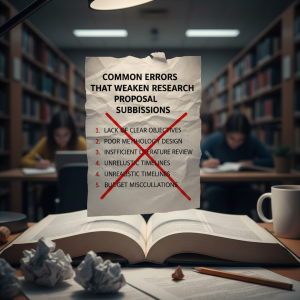
Common Errors That Weaken Research Proposal Submissions
Many promising projects fail due to preventable mistakes in proposal composition. Vague research questions that lack specificity frequently doom otherwise interesting studies. Proposals that present literature reviews as mere summaries rather than analytical syntheses appear superficial. Unrealistic timelines that underestimate data collection complexity signal inexperience. Perhaps most damaging is the failure to clearly link methodology to research questions—a disconnect that suggests methodological confusion. Finally, poor writing quality, including grammatical errors and inconsistent formatting, creates negative impressions about your attention to detail and academic professionalism.
Final Verification Checklist Before Proposal Submission
Before final submission, conduct a comprehensive review of your document. Verify that your research questions directly stem from identified literature gaps and align perfectly with your methodology. Ensure every section contributes to a cohesive argument for your project’s necessity and feasibility. Confirm adherence to all institutional formatting guidelines, including page limits, margin specifications, and required sections. Seek feedback from peers or mentors who have successfully navigated the proposal process, incorporating their suggestions to strengthen your arguments. Proofread meticulously, as even minor errors can undermine reviewer confidence in your scholarly capabilities.
Conclusion: Mastering the Skill to Write a Research Proposal
Developing expertise in how to write a research proposal transforms your academic trajectory, unlocking access to funding opportunities and research approvals. By following this systematic approach—preparing thoroughly, structuring logically, writing persuasively, and reviewing meticulously—you create a document that not only meets requirements but genuinely excites reviewers about your project’s potential. Remember that proposal writing is a skill developed through practice; each submission provides valuable lessons for refining your technique. Invest the necessary time and intellectual energy in this crucial document, as a compelling research proposal serves as the foundation upon which successful scholarly careers are constructed.