


Common Reasons for Rejection of Research Papers

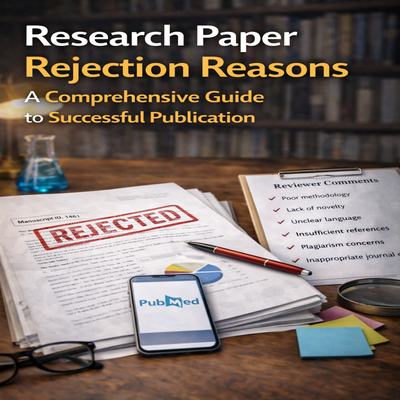
Research Paper Rejection Reasons: A Comprehensive Guide to Successful Publication
Picture this: you’ve spent months—maybe even years—designing experiments, collecting data, running analyses, and painstakingly writing up your findings. You finally submit your manuscript to what you thought was the perfect journal, only to receive that dreaded email starting with “We regret to inform you that your manuscript has been rejected.” It’s a scenario that plays out for countless researchers, from anxious PhD students to seasoned professors with decades of experience. But here’s what many don’t realize: a staggering number of these rejections are entirely preventable, rooted in common, recurring mistakes that have nothing to do with the actual quality of the science itself. Understanding these manuscript rejection causes isn’t just about avoiding failure—it’s about dramatically increasing your odds of joining the elite group of published authors.
This guide goes far beyond simply listing reasons papers get rejected. We’ll explore the underlying psychology of editors and peer reviewers, decode the unwritten rules of academic publishing, and provide you with actionable strategies to transform your submission from a likely rejection into a strong candidate for acceptance. Whether you’re preparing your first submission or your fiftieth, the insights here will reshape how you approach the publication process.
Misalignment with Journal’s Aims and Scope: The Gatekeeper’s First Filter
Let’s start with the most fundamental—and most commonly overlooked—reason for rejection. Every academic journal operates within carefully defined boundaries known as their “Aims and Scope.” This isn’t just bureaucratic jargon; it’s the editorial compass that determines everything they publish. When you submit a paper that falls outside these boundaries, you’re essentially asking a vegan restaurant to serve your prized steak recipe. It doesn’t matter how perfectly cooked it is—it’s simply not what they do.
The peer review process begins long before your manuscript reaches actual reviewers. An editor—often a busy academic volunteering their time—scans your submission for one critical factor: does this fit our journal? Submitting a detailed case study to a journal that explicitly publishes only systematic reviews will result in immediate rejection, regardless of how fascinating your case might be. The same fate awaits a theoretical physics paper sent to a journal focused on applied engineering, or a clinical psychology study submitted to a basic neuroscience publication. These mismatches happen with surprising frequency, often because authors adopt a “spray and pray” approach, firing off manuscripts to multiple journals without proper vetting.
How do you avoid this cardinal sin? First, invest genuine time in reading recent issues of your target journal. Not just skimming abstracts, but actually downloading and reading 5-7 full papers from the past two years. Pay attention to the methodologies employed, the theoretical frameworks used, and the types of conclusions drawn. Does your work speak the same intellectual language? Second, analyze the editorial board’s composition. Are these the scholars who would naturally cite your work? If not, you’re probably targeting the wrong venue. Third—and this is crucial—examine the journal’s stated aims on their website and compare them against your paper’s core contribution. For detailed guidance on selecting the appropriate journal, you might find our article on 10 Tips for Choosing the Right Journal for Your Research Paper extremely helpful.
Remember, editors are gatekeepers protecting their journal’s brand and readership. A misaligned submission signals that you haven’t done your homework, creating a negative first impression that’s nearly impossible to overcome. Worse, it wastes everyone’s time—yours most of all. Each rejection cycle can cost you 3-6 months, a delay you simply can’t afford in today’s hyper-competitive academic environment.
Technical and Structural Issues: When Formatting Decides Your Fate
You might believe that substance trumps style, that groundbreaking science will shine through any formatting flaws. Let’s be honest—that’s simply not how academic publishing works. Journal editors receive hundreds of submissions monthly and use formatting compliance as an objective first screen to reduce their workload. A manuscript that ignores author guidelines telegraphs one clear message: this author is either careless, disrespectful of the journal’s standards, or both. Neither quality inspires confidence in your research rigor.
These guidelines aren’t arbitrary hurdles designed to frustrate authors. They create consistency across publications, enable efficient peer review, and streamline the production process for accepted papers. Word count limits ensure fair distribution of journal space. Citation styles allow readers to efficiently track sources. Figure formats guarantee print quality. When you submit a 7,500-word paper to a journal with a strict 5,000-word limit, you’ve demonstrated an inability to follow basic instructions—prompting editors to wonder what other corners you might have cut in your actual research.
Font specifications, margin sizes, and file naming conventions might seem trivial, but they matter enormously. For instance, many Elsevier journals require manuscripts in double-spaced, single-column format with line numbers for review purposes. Others, particularly in computer science, expect single-spaced, double-column PDFs. Submitting the wrong format forces editorial staff to either reformat your work (which they won’t do) or return it immediately. This is one of the fastest rejection pathways, often occurring within days of submission.
The solution requires meticulous attention to detail. Create a pre-submission checklist based on the journal’s guidelines. Verify every element: abstract length, keyword count, figure resolution, table formatting, reference style, supplementary material requirements. Use the journal’s manuscript template if they provide one. Better yet, download a recently published article from that specific journal and use it as a visual guide for your own formatting. This simple step can prevent months of unnecessary delay.
Flawed Research Design: The Foundation That Determines Everything
Beyond formatting and fit lies the heart of any manuscript: the study design. Peer reviewers, who are experts in your field, will dissect your methodology with surgical precision. Any weakness here becomes an open invitation for rejection, because flawed methods produce unreliable results—regardless of how impressive your findings might appear on the surface.
Common design failures include poorly formulated research questions that lack conceptual clarity. If reviewers can’t understand what you’re actually investigating, they can’t assess your contribution. Your research questions should be specific, measurable, and grounded in existing literature gaps. Vague questions like “What are the effects of social media on mental health?” signal a poorly conceptualized study. Contrast this with a precise query: “How does passive scrolling through image-rich social media platforms affect state anxiety levels in undergraduate students aged 18-22 over a two-week period?” The latter demonstrates clear thinking and feasible investigation.
Methodological obsolescence represents another frequent pitfall. Using outdated analytical techniques when contemporary methods exist raises red flags. If you’re analyzing complex survey data, reviewers expect modern approaches like structural equation modeling, not simple correlation analyses from the 1990s. Similarly, inadequate sample sizes undermine statistical power and generalizability. Conducting a power analysis before data collection isn’t optional—it’s a hallmark of rigorous research. Submitting a clinical trial with 20 participants when established standards require at least 80 demonstrates either ignorance of field norms or resource constraints that compromise validity.
Control variables present another minefield. Failing to account for obvious confounding factors suggests sloppy experimental design. If you’re studying the effect of a new teaching method on student performance, you must control for prior knowledge, socioeconomic status, motivation levels, and other pedagogical factors. Omitting these controls makes your results uninterpretable and your manuscript unpublishable.
The antidote? Before collecting a single data point, create a detailed research protocol. Map out your theoretical framework, operationalize all variables, justify your sample size with power calculations, and articulate how you’ll control for confounders. Have colleagues review your design before you begin. Many rejections originate from problems that were completely solvable before data collection ever started.
Absence of Originality, Novelty, or Significance: The “So What?” Problem
Journal editors constantly ask one question: “So what?” If your paper doesn’t provide a compelling answer, rejection is virtually guaranteed. Academic publishing operates on a principle of incremental advancement. Your manuscript must contribute something new—whether that’s novel empirical findings, innovative methodology, fresh theoretical insights, or unexpected applications of existing knowledge. Simply replicating previous work or applying established methods to a marginally different context rarely suffices for top-tier journals.
The originality problem manifests in several ways. Some authors conduct literature reviews so superficial they unknowingly duplicate published studies. Others frame their research as “the first study to examine X in population Y,” when in reality, several similar studies exist. This highlights the importance of a truly comprehensive literature review that spans multiple databases, includes both published and gray literature, and extends back far enough to capture foundational work while focusing on recent developments.
Significance extends beyond novelty. Your findings must matter to the field. Ask yourself: Will other researchers cite this work? Could practitioners apply these results? Does this challenge existing paradigms or confirm them in important ways? A study might be original yet trivial. Discovering that students prefer blue notebooks over red ones might be original, but lacks significance. Contrast this with research showing that blue-tinted paper reduces reading errors in dyslexic students—that’s both original and significant.
To avoid this rejection reason, position your work within the broader scholarly conversation. Your introduction should clearly articulate the research gap you’re filling. Your discussion section must explicitly state how your findings advance knowledge. Don’t make reviewers guess why your work matters—tell them directly, confidently, and with supporting evidence from the literature. Cite recent high-impact papers and explain how your research extends, challenges, or refines their conclusions.
Subpar Manuscript Preparation and Writing Quality: When Communication Fails
Even brilliant research can die on the page due to poor writing. Peer reviewers serve as volunteer gatekeepers, typically reviewing manuscripts in their scarce free time. Dense, convoluted prose tests their patience and increases their cognitive load. If they struggle to understand your argument, they’ll likely recommend rejection rather than requesting extensive rewrites. Journal editors, aiming to minimize reviewer burden, often reject poorly written papers outright.
Writing problems extend far beyond grammar errors (though those certainly don’t help). They include unclear logical flow between paragraphs, inconsistent terminology, excessive jargon, and redundant explanations. Many authors mistakenly believe longer sentences sound more academic. The opposite is true. Clear, concise writing demonstrates mastery of your subject. Compare these two sentences: “The results of the present investigation indicate that there exists a statistically significant positive correlation between variable X and variable Y” versus “Our results show X and Y are positively correlated (p<0.01).” The second version conveys the same information more powerfully and professionally.
Structural issues plague many submissions. The classic IMRaD structure (Introduction, Methods, Results, and Discussion) exists for good reason—it creates a logical narrative arc. Yet authors frequently deviate, burying key findings in the Methods or presenting new data in the Discussion. Each section serves a distinct purpose. The Introduction should justify the study; Methods should enable replication; Results should present findings without interpretation; Discussion should contextualize results and acknowledge limitations.
The solution involves multiple rounds of revision. Write your first draft quickly, focusing on ideas rather than perfection. Then revise with a critical eye, asking: Does each paragraph serve a clear function? Are transitions smooth? Have I eliminated every unnecessary word? Reading your manuscript aloud reveals awkward phrasing and convoluted syntax. Better yet, exchange papers with a colleague for mutual editing. Fresh eyes catch problems you’ve become blind to after weeks of writing.
Overly Specialized Research with Limited Audience Appeal
There’s a delicate balance between depth and accessibility. While specialization demonstrates expertise, research so niche it interests only a handful of specialists faces steep publication odds. Most journals, even highly specialized ones, aim to serve communities of hundreds or thousands of researchers, not dozens. They need papers that advance conversation within their field while remaining comprehensible to related sub-disciplines.
Consider a study developing a highly specific mathematical algorithm for a narrow application in quantum computing. If you can’t articulate potential applications to classical computing, cryptography, or optimization problems, reviewers may label your work “too specialized.” This isn’t a critique of the science itself, but of its perceived impact and audience reach.
The key is framing. Every specialized study has broader implications—you must identify and articulate them. How might your method adapt to other problems? What conceptual advances does your work enable? Does it challenge assumptions in adjacent fields? Your discussion section should explicitly address these questions, creating bridges from your specific findings to wider intellectual territories.
Alternatively, target journals specifically dedicated to niche topics. Many fields have ultra-specialized publications where narrow focus is expected and valued. The challenge lies in honestly assessing whether your work suits a mainstream journal or requires a more specialized venue. Submitting a hyper-focused technical report to a broad-readership journal like Nature or Science wastes everyone’s time and sets you up for inevitable rejection.
Inadequate Theoretical Framework and Literature Review: The Context Problem
Your theoretical framework and literature review don’t just summarize existing knowledge—they provide the intellectual justification for your entire study. When reviewers encounter a weak framework, they question your understanding of the field. When literature reviews are incomplete or outdated, they wonder if you’re aware of critical developments that might invalidate your approach.
Strong literature reviews synthesize rather than list. They don’t merely report that “Smith (2020) found X” and “Jones (2021) found Y.” Instead, they identify patterns, contradictions, and gaps across the body of work. They show how your study emerges from ongoing scholarly debates. This synthesis demonstrates your expertise and positions your research as a natural next step.
Outdated literature is another common flaw. Citing only papers from the 1990s suggests you’re disconnected from current discourse. While classic foundational works matter, reviewers expect engagement with recent research—typically from the past 3-5 years. They want to see that you’re building on the latest findings, not rehashing old debates.
The theoretical framework deserves equal attention. It should logically connect your research questions to established concepts and theories. Simply mentioning a theory in passing isn’t enough. You must explain how it informs your hypotheses, shapes your methodology, and frames your interpretation of results. A well-developed framework transforms your study from a collection of isolated findings into a coherent contribution to scientific understanding.
Language Barriers: The Invisible Wall for Non-Native Speakers
For researchers whose first language isn’t English, writing presents a formidable challenge. Grammatical errors, awkward phrasing, and unclear expression can obscure brilliant science. Reviewers, who are not language instructors, may lack patience for manuscripts requiring extensive linguistic revision. Many journals now offer professional editing services, but these come at a cost and don’t guarantee acceptance.
The problem extends beyond simple grammar. Cultural differences in academic writing style affect how arguments are constructed. Some languages value elaborate, ornate expression, while English academic writing prizes directness and concision. Direct translation rarely works. We often see manuscripts where sentences stretch across half a page, burdened with subordinate clauses that obscure the main point.
What can you do? First, utilize available tools judiciously. Software like Grammarly, ProWritingAid, or the Hemingway Editor can catch basic errors and improve readability. But treat them as assistants, not replacements for human judgment. Second, invest in professional editing if possible. Many universities offer writing centers with free services for graduate students and faculty. Third, seek out collaborative writing partnerships. Offer to co-author with colleagues who have stronger English skills, contributing your scientific expertise while they help refine the prose.
Most importantly, read extensively in your target journals. Internalize their rhythm, structure, and vocabulary. Notice how published authors construct arguments and present evidence. This immersion builds an intuitive sense of appropriate academic style that no grammar checker can replicate.
Frequently Asked Questions About Academic Publishing Rejection
Why do even high-quality manuscripts sometimes get rejected?
This question plagues many researchers, and the answer reveals the competitive nature of scholarly publishing. Quality alone doesn’t guarantee acceptance because journals operate within strict constraints. They have limited pages per issue, specific thematic balances to maintain, and varying acceptance rates based on their target impact factor. A technically flawless paper might be rejected because the journal recently accepted a similar study, or because its findings, while solid, don’t represent a sufficiently dramatic advance. Additionally, reviewers bring subjective perspectives. One reviewer’s “incremental contribution” might be another’s “significant breakthrough.” The “so what” factor—how reviewers perceive your work’s importance—plays a huge role. Sometimes rejection simply means your paper fits better elsewhere. Always remember: rejection from one journal doesn’t invalidate your research’s quality or importance.
Can I resubmit the same paper to the same journal after revision?
Generally, yes—but only under specific circumstances. If your paper received a “reject and resubmit” or “major revisions” decision, the editor has essentially invited you to try again after thorough revision. In this case, you must treat the resubmission as a new manuscript while including a detailed response letter addressing every reviewer comment point-by-point. Explain exactly how you’ve revised the paper in response to each critique. However, if you received a firm rejection without encouragement to resubmit, sending the same paper back is usually futile and may annoy the editor. One exception exists: if you’ve fundamentally reconceptualized and rewritten the paper—adding new data, reframing the entire argument, essentially creating a new study on the same topic—then a fresh submission might be considered. But this is rare, and you should disclose the previous submission in your cover letter.
How long does the rejection process typically take?
Timelines vary dramatically across journals and rejection types. Desk rejections—when the editor returns your paper without peer review—often arrive within 3-10 days. These rapid decisions usually stem from clear misalignment with journal scope or glaring formatting violations. Rejections after peer review take longer, typically 4-12 weeks, depending on reviewer responsiveness and editorial workload. Some journals operate “reviewer cascading” systems, where if you’re rejected from their flagship journal, they might offer automatic transfer to a sister publication. This can extend timelines but provides alternative publication pathways. Top-tier journals with high submission volumes and rigorous review processes might take 3-4 months to reach a rejection decision. Always check the journal’s website for average decision times, and use this information strategically when planning your submission timeline—especially if you’re working against graduation or promotion deadlines.
Conclusion: Turning Rejection into Opportunity
Rejection remains an integral, if unwelcome, component of academic life. Even Nobel laureates have drawers full of rejected manuscripts. The critical difference between successful and struggling researchers isn’t avoiding rejection altogether—it’s learning from each setback and emerging stronger. Every rejection letter, painful as it feels, contains valuable intelligence about how to improve your work and position it more effectively.
The strategies outlined here—careful journal targeting, meticulous adherence to guidelines, rigorous methodology, clear writing, and compelling framing of significance—aren’t secret tricks. They represent the professional standards expected by top-tier journals. Mastering them requires conscious effort and practice, but the payoff extends far beyond any single publication. These skills make you a better researcher, a clearer thinker, and a more effective communicator of science.
Remember that the academic publishing landscape evolves constantly. New journals emerge, submission systems update, and reviewer expectations shift. Stay engaged with your professional community, attend publishing workshops, and maintain relationships with mentors who can provide candid feedback. Persistence, coupled with strategic refinement of your approach, will ultimately lead to success. Your research deserves to be read—ensure you give it the best possible chance to shine.


I will immediately snatch your rss as I can not find your e-mail subscription hyperlink or e-newsletter service. Do you’ve any? Please let me understand so that I may just subscribe. Thanks.
Please send your email address so we can add you to our newsletter mailing list.
Thank you for your interest.