


Why Is My Paper Rejected So Many Times?


Paper Rejection Reasons: Understanding Why Your Research Gets Rejected
Link to our website homepage: https://eurekapapers.com/
Paper rejection reasons are crucial for every researcher who has faced that cold “Reject” label on their hard work. Have you ever wondered why your carefully written paper keeps getting rejected? What are the main paper rejection reasons that cause scientific research to fail during peer review? If these questions sound familiar, know that you’re not alone. Many researchers, from PhD students to experienced professors, have faced the bitter experience of paper rejection at least once in their academic career. Some have even repeated this experience multiple times to the point where they may have started doubting their own scientific abilities.
But here’s a point you might not have considered at all: paper rejection doesn’t necessarily indicate low quality research. Rather, it often signals a gap between what you’ve presented and what the journal expects. This gap can be identified and fixed. In this article, we comprehensively examine the main paper rejection reasons and provide practical solutions that can significantly increase your chances of acceptance. So let’s dive into the reasons that might have trapped you in this vicious cycle.
Did You Know That Over 50% of Papers Are Rejected on First Submission?

First of all, let’s accept the realities of this field. According to credible publication statistics from Nature and Elsevier, more than half of the papers submitted to reputable scientific journals are rejected in the initial stage or after the first round of review. This number even reaches 70% in some top-tier international journals. But these statistics shouldn’t discourage you; rather, they should show that the paper acceptance process is a numbers game and you should adjust your strategy based on these facts.
The critical point is that many of these rejections result from preventable mistakes. Mistakes you may have unknowingly made yourself. For instance, did you know that about 30% of initial rejections happen simply because the paper’s topic doesn’t match the journal’s scope? Or that methodological flaws are responsible for 40% of post-review rejections? These figures show that with a little care and awareness, you can avoid many of these traps.
The Main Reason for Paper Rejection: Mismatch with Journal Scope
One of the most common yet simplest reasons for paper rejection is submitting it to a journal that doesn’t align with your research area at all. Imagine sending a paper about plant genetic engineering to a specialized particle physics journal. What would be the result? Definitely a swift rejection within the first few hours by the scientific editor. This is a mistake even experienced researchers sometimes make, perhaps in an attempt to increase the impact factor or journal metrics.
To prevent this problem, you must first conduct thorough research about your target journal. Have similar papers to your topic been published in recent issues? Does the journal have a broad or highly specialized scope? Does your paper fit into the journal’s subject categories? You should answer these questions by carefully examining the Author Guidelines and reviewing the journal’s archive. Particularly, paying attention to the “Aims and Scope” section of the journal can save you from an early rejection.
Methodological Quality: The Achilles’ Heel of Rejected Papers
Let’s assume your paper’s topic perfectly matches the journal. But is your research methodology strong and flawless? This is where many papers face serious problems. Reviewers, with sharp eyes, look for weaknesses in research design, sampling, measurement tools, and data analysis. If even one of these aspects is questionable, the probability of rejection increases exponentially.
One common problem is insufficient or non-valid sampling. For example, in qualitative research, the number of participants should reach theoretical saturation; while in quantitative research, sample size should be calculated based on statistical formulas. Have you followed these principles? Or did you use a smaller sample just due to time or budget constraints? Reviewers can easily identify these issues and consider them serious flaws.
Another problem is lack of clarity in data collection and analysis methods. Have you clearly explained how you collected your data? What tools were used and why? How did you ensure the validity and reliability of your measurement instruments? If this section is vague or incomplete, reviewers cannot trust your results and therefore vote to reject the paper.
Major Structural Flaws That Cause Repeated Rejections
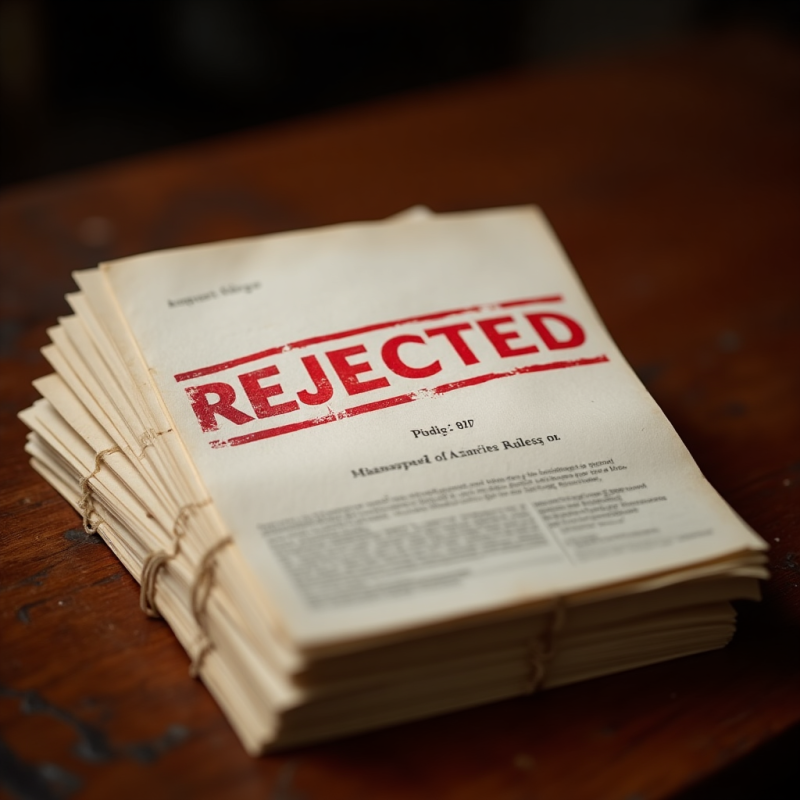
Inappropriate structure of a paper is another major cause of rejection. A standard scientific paper is like a building; if its foundation isn’t strong, the entire structure collapses. Different sections of a paper—from abstract to conclusion—must be cohesively and logically connected. But which sections have the most problems?
Weak Abstract: The abstract is the first section reviewers and readers see. If your abstract cannot clearly present the problem, method, findings, and results in an engaging format, reviewers’ motivation to continue reading decreases. The abstract should be between 150-250 words and cover all key aspects of the research. Unfortunately, many authors either write abstracts too long or omit critical points.
Vague Introduction: The introduction should act like a roadmap and gradually guide the reader from the general problem to the research gap and then to the main research question. But many introductions are either too vague or too long and full of unnecessary information. Have you clearly stated in your introduction why this research is important and what it adds to existing knowledge?
Writing and Language Issues: Is Your Paper’s Language Scientific?
Even if your paper’s scientific content is unique and strong, language problems can destroy it. This issue is especially critical for authors whose native language isn’t English. Grammar errors, incorrect vocabulary, complex and unclear sentences, and failure to follow scientific writing style can all lead to paper rejection. Many journals reject papers solely due to poor writing quality because correcting them takes too much time from editors.
What’s the solution? Using professional editing services or seeking help from colleagues fluent in English. Also, tools like Grammarly or similar software can help improve writing quality. But is this enough? No. You must also learn scientific writing style by studying top papers in your field. Sentences should be clear, precise, and concise. Use active verbs instead of passive ones and avoid words with imprecise meanings.
One effective technique is to read each section aloud after writing it. If reading a sentence aloud is difficult for you, rest assured it will be difficult for reviewers too. Simplicity and clarity are the keys to success in scientific writing.
Literature Review Deficiencies: Why Is This Section Critical?
The literature review section is the heart of your paper. This is where you show how your research fits into the existing knowledge fabric. But many authors dedicate this section only to listing previous studies without establishing logical connections between them. This is a mistake that can quickly lead to paper rejection.
A good literature review should clearly show the knowledge gap. You must be able to argue why previous research is insufficient and how your study fills this gap. Have you only used old sources? Have you overlooked key recent research? Do your sources have sufficient diversity or do you rely on just a few specific ones? These are the questions reviewers have in mind.
Another common problem is the lack of critique in literature review. You shouldn’t just say “Researcher X found Y result”; rather, you should be able to critique that result and show how your research can complement or challenge it. This demonstrates your critical thinking and is highly valued by reviewers.
Weak Results or Overclaiming: The Thin Line Between Rejection and Acceptance
The Results section is where you present your research findings. But there are numerous pitfalls here that can lead to paper rejection. One of these is presenting weak or unjustifiable results. For example, if your research was conducted on a small sample and doesn’t have statistically significant results, why should you expect acceptance? Reviewers look for strong, significant, and generalizable results.
But the other extreme is also dangerous: overclaiming results. Many authors, especially in the Discussion section, make claims that their data cannot support. For instance, if your research was only conducted on a specific population, you cannot claim that the results are generalizable to all societies. This type of overstatement is a major sign of scientific carelessness and is quickly identified by professional reviewers.
What’s the solution? Scientific honesty. Present your results exactly as they are, without exaggeration. If you have weak results, instead of hiding them, try to explain why and provide suggestions for future research. This demonstrates your ability to analyze research limitations.
Importance of Proper Journal Selection: The Golden Key to Reducing Rejections
Now let’s discuss one of the most important strategies that can drastically reduce your paper’s rejection probability: smart journal selection. Many researchers only chase high-impact-factor journals and send their papers to them without considering topical fit. This strategy is like running in the Olympics without preparation. The result will be nothing but failure.
For proper selection, you must consider several factors. First, content fit: Is the journal interested in your topic? Second, journal level: Does your research quality match the journal’s standards? Third, review time: Can you wait or do you need quick results? Fourth, journal acceptance rate: Some journals have acceptance rates below 10%; is the risk worth it?
An effective technique is to use tools like Journal Finder (Elsevier) or Journal Suggester (Springer). These tools analyze your paper’s title, abstract, and keywords to suggest appropriate journals. Also, examining the reference papers you’re citing can give you good ideas about which journals show interest in your topic.
How to Respond to Reviewers’ Comments?

Suppose your paper has passed the initial stage and you’ve now received reviewers’ comments. This is where many researchers make serious mistakes. Some, upon seeing negative comments, abandon the paper and send it to another journal. This strategy might work in the short term, but in the long term, it deprives you of learning and improvement opportunities.
The appropriate response to reviewers’ comments is a systematic process. First, before anything else, give yourself time. Harsh comments can hurt your feelings, but responding emotionally makes things worse. After calming down, categorize the comments: which ones are correct and need correction? Which ones are based on misunderstanding and need clarification? Which ones are just matters of taste and you can respectfully disagree with?
In your response to the editor, you should address each comment point by point. For each critique, explain what corrections you’ve made or why you think the critique is unjustified. This demonstrates your professionalism. Many papers that were rejected in the first review round get accepted in the second round with proper response to comments. So take this stage seriously.
Practical Strategies to Reduce Paper Rejection Probability
Now that we’re familiar with the main reasons for paper rejection, let’s discuss strategies that can reduce this probability. These strategies combine prevention and action, and if implemented correctly, can have a tremendous impact.
Before Starting to Write
- Detailed planning: Before writing even a single word, prepare an outline of your paper. Specify what message each section will convey.
- Journal research: As mentioned, consider journal selection from the very beginning.
- Form a peer review group: Find a few colleagues who can read your paper before journal submission and provide constructive criticism.
During Writing
- Follow author guidelines: This is a simple but critical point. Many journals quickly reject papers that haven’t followed even the smallest instructions.
- Balance between sections: One section shouldn’t be too short while another is too long. For example, if your Results section is only one paragraph but your Introduction is five pages, it’s a sign of imbalance.
- Use visuals: Tables, charts, and figures can simplify paper complexities. But they must be high quality and properly captioned.
After Writing
- Multiple rounds of editing: Edit your paper at least three times. Once for content, once for structure, and once for language.
- Check for plagiarism: Use tools like Turnitin or iThenticate to ensure your paper is original.
- Write a cover letter: The letter you write to the editor is very important. In it, you should clearly state why your paper is suitable for that journal and what its contribution is.
- Table: Final Checklist Before Paper Submission
| Criterion | Yes | No | Notes |
| Does the paper topic completely match the journal scope? | |||
| Is the abstract within word limit and covering all points? | |||
| Is methodology fully and clearly explained? | |||
| Are recent and credible sources used? | |||
| Has plagiarism been checked? | |||
| Are charts and tables high quality and error-free? | |||
| Are charts and tables high quality and error-free? | |||
| Are charts and tables high quality and error-free? |
Complete this checklist before hitting the submit button. If even one checkmark is missing, don’t send the paper and complete it first.
What Lessons Should You Learn for Your Next Paper?
Now that your paper has been rejected, what should you do? The first and most important thing is to view this experience as a learning opportunity. Every rejection carries a message. Perhaps it’s time to adjust your expectations or increase your research quality. But don’t forget this: paper rejection is not rejection of you as a researcher. It’s just feedback for improvement.
For your next paper, apply everything you’ve learned. You might need to design a stronger methodology or completely change the paper structure. Also, when writing a paper, it’s better to expect rejection and plan which journal to target next if rejected. This strategy reduces the psychological pressure of rejection.
Frequently Asked Questions About Paper Rejection Reasons
Why was my paper rejected without review?
This usually happens due to mismatch with journal scope, formatting issues, or very low writing quality. The scientific editor screens papers based on these criteria in the initial stage. To prevent this, carefully read the author guidelines and use editing tools.
Can I appeal a paper rejection?
Yes, but it’s generally not recommended. If you think the review was clearly biased or unscientific, you can write to the editor. But it must be polite and with strong evidence. In most cases, it’s better to accept the comments, revise the paper, and submit to another journal.
How many times can I resubmit a paper after rejection?
There’s no specific number, but you must be reasonable. If more than five journals have rejected it, perhaps you should question its quality. In such cases, it’s better to get help from an expert or research consultant to identify the main problems. Sometimes, a complete rewrite is necessary.