


Digital Twin: A New Frontier in Computer and Management Science Research

Why Digital Twin Technology Matters Now More Than Ever
Have you ever wondered how engineers test airplane engines without actually flying, or how city planners predict traffic jams before they happen? Welcome to the fascinating world of Digital Twin technology—a revolutionary concept that is reshaping both computer science and management science in ways we couldn’t have imagined just a decade ago.
A Digital Twin is essentially a dynamic, virtual replica of a physical object, process, or system. But here’s what makes it truly special: unlike static 3D models or simple simulations, a Digital Twin receives real-time data from its physical counterpart, enabling it to evolve, learn, and predict future behaviors. This bidirectional flow of information creates a bridge between the physical and digital realms, offering unprecedented opportunities for optimization, monitoring, and innovation.
The concept isn’t entirely new. NASA pioneered similar approaches during the Apollo missions, creating physical duplicates of spacecraft systems to troubleshoot issues from Earth. However, the modern incarnation of Digital Twins—powered by IoT sensors, artificial intelligence, cloud computing, and advanced analytics—has transformed this idea from a niche engineering tool into a mainstream business imperative. According to recent industry analyses, the global Digital Twin market is projected to exceed $48 billion by 2026, growing at a compound annual growth rate of over 58%. That’s not just impressive; it’s indicative of a fundamental shift in how organizations approach problem-solving and decision-making.
But why should researchers in computer and management science pay attention? The answer lies in the interdisciplinary nature of this technology. Digital Twins sit at the intersection of multiple domains: data science, systems engineering, operations research, organizational behavior, and strategic management. They require sophisticated algorithms for real-time processing, robust cybersecurity frameworks, and entirely new approaches to governance and value creation. For academics and practitioners alike, this represents a goldmine of research opportunities that can drive both theoretical advancement and practical impact.
In this comprehensive exploration, we’ll dive deep into the technological foundations of Digital Twins, examine their transformative applications across industries, analyze the management challenges they present, and identify the most promising avenues for future research. Whether you’re a computer scientist interested in distributed systems and AI, or a management scholar studying organizational transformation, this emerging field offers something compelling for your intellectual curiosity.
The Technological Architecture: Building Blocks of Digital Twin Systems
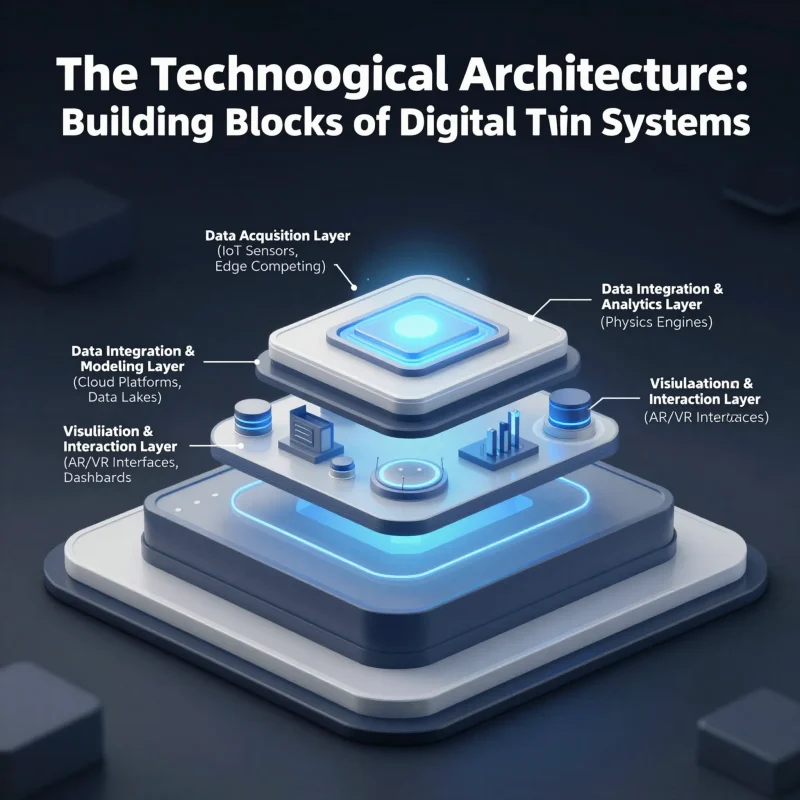
Understanding how Digital Twins actually work requires appreciating the sophisticated technological stack that enables their functionality. At its core, a Digital Twin architecture consists of three essential layers, each presenting unique research challenges and opportunities for computer scientists.
The Data Acquisition Layer: Sensing the Physical World
The foundation of any Digital Twin lies in its ability to capture high-fidelity data from the physical entity it represents. This involves an intricate network of Internet of Things (IoT) sensors, RFID tags, cameras, and other data collection devices that continuously monitor various parameters—temperature, pressure, vibration, location, usage patterns, and environmental conditions. The sheer volume and velocity of this data stream pose significant challenges in edge computing, data transmission protocols, and real-time processing.
Modern Digital Twins often employ edge computing architectures where preliminary data processing occurs near the source, reducing latency and bandwidth requirements. This distributed computing paradigm raises fascinating questions about optimal task allocation between edge devices and cloud infrastructure. How do we balance the need for immediate response times against the computational power available in centralized servers? What algorithms best determine which data should be processed locally versus transmitted to the cloud? These questions sit squarely within computer science research domains, particularly in distributed systems and network optimization.
Furthermore, the heterogeneity of data sources creates integration challenges. A manufacturing Digital Twin might need to synthesize information from legacy SCADA systems, modern IoT sensors, enterprise resource planning (ERP) software, and external data feeds like weather APIs. Developing ontologies and middleware solutions that can harmonize these disparate data streams into a coherent digital representation remains an active area of research with significant practical implications.
The Modeling and Simulation Layer: Creating the Virtual Replica
Once data is acquired, it must be translated into a functional virtual model. This layer represents the heart of Digital Twin technology, where various modeling techniques come into play depending on the complexity of the physical system and the intended applications.
For geometrically complex objects, Computer-Aided Design (CAD) models provide the visual foundation, often enhanced with Building Information Modeling (BIM) in construction contexts or 3D laser scanning for as-built documentation. However, Digital Twins go far beyond mere geometry. They incorporate physics-based simulations using finite element analysis (FEA), computational fluid dynamics (CFD), or multi-body dynamics to predict how the physical entity will behave under different conditions.
The integration of machine learning models has dramatically expanded the capabilities of this layer. Rather than relying solely on first-principles physics simulations—which can be computationally expensive and require extensive calibration—researchers are increasingly using data-driven approaches. Deep learning architectures, particularly recurrent neural networks (RNNs) and Long Short-Term Memory (LSTM) networks, excel at capturing temporal dependencies in time-series data, making them ideal for predictive maintenance applications. Meanwhile, physics-informed neural networks (PINNs) attempt to combine the interpretability of physical laws with the flexibility of machine learning, representing a promising hybrid approach that respects known constraints while learning from data.
The challenge of model fidelity versus computational efficiency presents a rich research agenda. High-fidelity simulations might take hours to run, making them unsuitable for real-time Digital Twin applications. Conversely, overly simplified models may miss critical dynamics. Adaptive modeling techniques that automatically adjust complexity based on the situation—sometimes called “variable-fidelity modeling”—offer an elegant solution but require sophisticated error estimation and control mechanisms.
The Application and Interface Layer: Delivering Value
The top layer of the architecture focuses on how insights from the Digital Twin are communicated to human decision-makers or automated systems. This encompasses visualization technologies ranging from traditional dashboards to immersive Virtual Reality (VR) and Augmented Reality (AR) environments that allow engineers to “step inside” their Digital Twins.
Natural language processing interfaces are emerging as important research frontiers, enabling non-technical stakeholders to query Digital Twins using conversational language. Imagine a factory manager asking, “Why is Production Line 3 underperforming today?” and receiving an intelligible explanation synthesized from multiple data sources and simulation results. Developing the semantic understanding and context awareness required for such interactions involves advances in human-computer interaction, knowledge representation, and explainable AI.
The integration layer also handles the bidirectional data flow that distinguishes Digital Twins from passive simulations. Not only does the virtual model receive data from the physical world, but it can also send commands back—adjusting control parameters, scheduling maintenance, or optimizing operations. This creates cyber-physical feedback loops that raise important questions about system stability, security, and autonomy. How much control should we cede to automated Digital Twin systems? What safeguards prevent cascading failures when virtual recommendations are implemented in the physical world? These questions blur the lines between technical computer science research and management science concerns about governance and risk.
Transformative Applications: Where Digital Twins Are Making Real Impact
The theoretical promise of Digital Twin technology becomes tangible when we examine its deployment across diverse sectors. Each application domain reveals unique challenges that drive innovation and offer lessons for researchers.
Manufacturing and Industry 4.0
The manufacturing sector has embraced Digital Twins most enthusiastically, viewing them as essential infrastructure for the fourth industrial revolution. In smart factories, Digital Twins of production lines enable real-time monitoring of equipment health, predictive maintenance scheduling, and optimization of throughput. Companies like Siemens and General Electric have reported significant reductions in unplanned downtime—sometimes by as much as 30-40%—through Digital Twin implementations.
Beyond individual machines, Digital Twins of entire manufacturing systems allow for virtual commissioning. Rather than physically assembling production lines and discovering integration issues through costly trial and error, engineers can simulate the entire system in a virtual environment first. This approach reduces time-to-market for new products and facilities while improving quality outcomes. The research implications here span operations research (optimizing production schedules), systems engineering (managing complexity), and organizational studies (understanding how virtual commissioning changes team dynamics and decision-making processes).
Quality management represents another fertile application area. By creating Digital Twins of individual products—tracking their journey through the manufacturing process and subsequent use—companies can trace quality issues to their root causes with unprecedented precision. This “product lifecycle Digital Twin” creates a comprehensive data record that supports everything from warranty management to circular economy initiatives like remanufacturing and recycling.
Smart Cities and Urban Infrastructure
Urban environments present perhaps the most complex application domain for Digital Twins, given the intricate interdependencies between transportation networks, energy grids, water systems, buildings, and human populations. City-scale Digital Twins integrate data from thousands of sensors with geospatial information systems, demographic data, and economic models to support planning and operations.
Singapore’s Virtual Singapore project exemplifies this ambition, creating a detailed 3D model of the entire city-state that serves multiple stakeholders. Urban planners use it to simulate the impact of new developments on traffic patterns and sunlight exposure. Emergency responders train in virtual environments that replicate real building layouts. Citizens visualize proposed changes to their neighborhoods before construction begins.
The management science research opportunities here are immense. How do we govern such complex, multi-stakeholder Digital Twin ecosystems? Who owns the data? Who pays for maintenance and updates? How do we ensure that Digital Twin insights translate into equitable policy outcomes rather than reinforcing existing biases? These governance questions are as challenging as the technical implementation, requiring interdisciplinary collaboration between computer scientists, urban planners, public policy experts, and organizational theorists.
Climate resilience represents an increasingly urgent application. Digital Twins of coastal cities can simulate flooding scenarios under various climate change projections, helping decision-makers evaluate adaptation strategies like seawall construction, green infrastructure, or managed retreat. The uncertainty inherent in climate projections creates interesting methodological challenges for simulation and decision-support systems.
Healthcare and Personalized Medicine
The healthcare sector is witnessing a paradigm shift toward personalized Digital Twins—virtual representations of individual patients that integrate genomic data, medical imaging, physiological measurements, and lifestyle information. These “virtual patients” enable clinicians to simulate treatment outcomes before administering actual therapies, potentially revolutionizing precision medicine.
Cardiovascular Digital Twins, for instance, combine MRI imaging with computational fluid dynamics to model blood flow through a patient’s specific vascular geometry. Surgeons can test different intervention strategies—stent placements, bypass configurations—in the virtual environment to identify the optimal approach. Pharmaceutical researchers use Digital Twins to simulate drug interactions at the molecular level, accelerating drug discovery while reducing reliance on animal testing.
The ethical and management dimensions of healthcare Digital Twins are particularly pronounced. Issues of data privacy, informed consent, and algorithmic bias take on life-or-death significance. How do we ensure that Digital Twins trained on predominantly certain demographic datasets don’t produce dangerous recommendations for underrepresented populations? What happens when a Digital Twin prediction contradicts a physician’s clinical judgment? These questions require careful integration of technical robustness with ethical frameworks and clinical governance structures.
Aerospace and Defense
The aerospace industry has long been at the forefront of Digital Twin development, driven by the extreme costs and safety requirements of aircraft and spacecraft systems. Modern jet engines contain thousands of sensors generating terabytes of data per flight, feeding Digital Twins that monitor structural integrity, thermal performance, and aerodynamic efficiency in real-time.
The U.S. Air Force’s initiative to create Digital Twins of entire aircraft fleets illustrates the strategic potential. These comprehensive virtual representations track the unique history and current state of each physical aircraft, accounting for the specific stresses experienced during missions, maintenance actions taken, and modifications made. This individualized tracking enables predictive maintenance that considers each aircraft’s actual condition rather than generic schedules, extending service life while ensuring safety.
Defense applications raise additional research questions about cybersecurity and resilience. Digital Twins of critical military systems represent high-value targets for adversaries. Developing architectures that maintain functionality even when individual components are compromised involves advances in distributed systems, cryptography, and Byzantine fault tolerance. The game-theoretic aspects of securing such systems—anticipating attacker strategies and designing optimal defenses—connect computer science with management science approaches to risk and strategy.
Management Science Perspectives: Organizational Transformation and Value Creation
While computer scientists focus on building Digital Twin capabilities, management scholars grapple with perhaps more fundamental questions: How do these technologies change organizations? What new business models emerge? How do we measure and capture value from Digital Twin investments?
Strategic Implications and Competitive Advantage
From a strategic management perspective, Digital Twins represent both an opportunity and a challenge to established competitive dynamics. They can serve as powerful isolating mechanisms, creating sustainable competitive advantages through data network effects. As a Digital Twin system accumulates more operational data, its predictive models improve, creating better outcomes that generate more data in a virtuous cycle. This dynamic can be difficult for competitors to replicate quickly.
However, Digital Twins also lower barriers to entry in some respects. Virtual prototyping and testing reduce the capital requirements for product development, potentially democratizing innovation. Startups can simulate and optimize designs that once required expensive physical testing facilities. The strategic implications depend heavily on industry context and the specific assets and capabilities involved.
Resource-based view theorists find rich material in analyzing how Digital Twins affect firm boundaries and capability development. Do companies build Digital Twin competencies in-house, or do they rely on specialized vendors? How do these decisions affect organizational learning and strategic flexibility? The answers vary across industries and firm characteristics, offering opportunities for empirical research that advances both theory and practical guidance.
Organizational Change and Digital Transformation
Implementing Digital Twin technology is rarely a purely technical exercise; it requires significant organizational change. Employees must develop new skills, workflows must be redesigned, and decision-making processes often shift from intuition-based to data-driven approaches. Management researchers study these transformation processes, identifying factors that distinguish successful implementations from costly failures.
Change management in Digital Twin initiatives involves overcoming resistance from employees who may fear job displacement or distrust algorithmic recommendations. It requires building data literacy across the organization, not just within IT departments. And it necessitates new forms of collaboration between traditionally siloed functions—operations, engineering, IT, and business units must work together in ways that challenge established organizational hierarchies.
The concept of “digital maturity” has emerged as a useful lens for understanding organizational readiness for Digital Twin adoption. Firms with strong foundational capabilities in data management, systems integration, and digital culture are better positioned to capture value from Digital Twin investments. Researchers are developing frameworks to assess and improve digital maturity, providing actionable insights for practitioners.
Business Models and Value Capture
Digital Twins enable new business models that blur traditional industry boundaries. Manufacturers increasingly offer “power-by-the-hour” or “outcome-based” contracts where customers pay for operational availability rather than capital equipment. Rolls-Royce pioneered this approach in aircraft engines, using Digital Twins to guarantee performance while retaining ownership of the physical assets. This servitization trend transforms capital expenditure into operational expenditure for customers while creating recurring revenue streams and deeper customer relationships for providers.
Platform business models are also emerging around Digital Twin technologies. Companies create ecosystems where multiple stakeholders—equipment manufacturers, software vendors, system integrators, and end-users—contribute to and benefit from shared Digital Twin infrastructure. Managing these multi-sided platforms involves complex pricing, governance, and coordination challenges that management scientists are only beginning to address.
The economics of Digital Twin data present fascinating research questions. Who owns the data generated by a Digital Twin? The equipment owner? The software provider? The operator? How should data be valued and priced when it creates value across multiple parties? These questions intersect with legal scholarship on intellectual property and emerging regulatory frameworks for data governance.
Risk Management and Governance
Digital Twins introduce new categories of risk that require sophisticated management approaches. Cybersecurity risks are paramount—compromising a Digital Twin could allow attackers to manipulate physical systems or steal sensitive operational data. The attack surface expands dramatically as more systems become connected and interdependent.
Operational risks also evolve. Over-reliance on Digital Twin predictions without adequate human oversight can lead to complacency and catastrophic failures when models encounter situations outside their training data—the “automation paradox” well-documented in human factors research. Developing appropriate human-machine collaboration protocols, including effective alarm systems and override mechanisms, is crucial.
Governance frameworks for Digital Twins must address accountability questions. When a Digital Twin recommendation leads to a suboptimal decision, who is responsible? The algorithm designers? The data providers? The decision-maker who followed the recommendation? These questions become particularly acute in regulated industries like healthcare and aviation, where clear lines of accountability are legally mandated.
Ethical governance extends beyond legal compliance. Digital Twins can amplify existing biases if trained on historical data that reflects discriminatory practices. They can enable surveillance capabilities that raise privacy concerns. And they can create power asymmetries between those who control Digital Twin infrastructure and those who are subject to its insights. Management researchers collaborate with ethicists and legal scholars to develop governance frameworks that promote beneficial innovation while protecting societal values.
Research Frontiers: Where Computer Science and Management Science Converge
The most exciting research opportunities lie at the intersection of technical capabilities and organizational implementation. Several frontier areas promise particularly high impact.
Scalable and Real-Time Analytics
As Digital Twins grow in scope—from individual components to entire systems of systems—the computational challenges become formidable. Developing algorithms that can update complex simulations in real-time, incorporating streaming data from thousands of sources, requires advances in distributed computing, approximate computing, and specialized hardware acceleration.
Edge intelligence architectures that push computation closer to data sources offer one promising direction. Rather than transmitting all data to centralized cloud servers, edge devices perform local processing and only share aggregated insights. This approach reduces latency and bandwidth requirements but introduces coordination challenges. How do we maintain consistency across distributed Digital Twin instances? How do we optimize the placement of computational tasks across the edge-cloud continuum? These questions engage computer science researchers in networking, distributed systems, and optimization.
Quantum computing represents a longer-term frontier with potentially transformative implications. Quantum algorithms for optimization and machine learning could enable Digital Twins of unprecedented scale and sophistication. Management researchers are exploring how organizations should prepare for quantum advantages and what strategic implications quantum-enabled Digital Twins might have for competitive dynamics.
Interoperability and Standards
The full potential of Digital Twins will only be realized when they can seamlessly interact across organizational boundaries. A supplier’s Digital Twin of a component should integrate effortlessly with an manufacturer’s Digital Twin of the final product, which in turn should connect with the operator’s Digital Twin of the deployed system. Achieving this interoperability requires technical standards for data formats, interfaces, and semantic models.
Standards development is inherently a socio-technical process involving competing interests and network effects. Management researchers study how standards emerge, how competing standards vie for dominance, and how organizations should strategize around standardization efforts. The interplay between technical design choices and competitive dynamics creates rich research opportunities.
Ontology engineering and semantic web technologies offer technical approaches to interoperability, creating shared vocabularies and logical relationships that enable machines to interpret data contextually. However, developing ontologies that satisfy diverse stakeholders while remaining computationally tractable is challenging. Research in knowledge representation and reasoning directly addresses these challenges.
Human-Digital Twin Interaction
As Digital Twins become more sophisticated and autonomous, understanding how humans interact with them becomes critical. This involves human-computer interaction research on interface design, cognitive engineering studies of decision-making with automated support, and organizational behavior research on trust in algorithmic systems.
Explainable AI (XAI) is particularly relevant. When Digital Twins make complex recommendations based on intricate machine learning models, how do we communicate the reasoning in ways that support appropriate human oversight? Different stakeholders may require different explanation types—engineers might want technical details about model uncertainty, while executives might prefer high-level summaries of risk and opportunity.
The concept of “meaningful human control” has emerged in discussions of autonomous systems, including those managed by Digital Twins. Determining the appropriate level of human involvement—neither excessive micromanagement that defeats the purpose of automation nor abdication of responsibility to opaque algorithms—is a nuanced challenge that varies by application context and risk level.
Sustainability and Circular Economy Applications
Digital Twins can play a crucial role in addressing environmental challenges. By optimizing resource use, extending product lifespans, and enabling circular business models, they offer pathways to sustainability that align economic incentives with environmental stewardship.
Life cycle assessment (LCA) integrated into Digital Twins allows real-time tracking of environmental impacts, from raw material extraction through manufacturing, use, and end-of-life. This visibility enables optimization for sustainability metrics alongside traditional cost and quality objectives. Researchers are developing multi-objective optimization algorithms that balance these competing considerations and exploring how organizations can effectively incorporate sustainability into Digital Twin-driven decision-making.
The circular economy—where products are designed for reuse, remanufacturing, and recycling—relies heavily on information about product condition and history. Digital Twins provide this information infrastructure, tracking each item’s journey and state to determine optimal recovery pathways. Management research examines the business model innovations required to capture value from circularity and the supply chain redesign needed to implement closed-loop systems.
Implementation Roadmap: From Concept to Value
For organizations considering Digital Twin initiatives, a structured approach helps navigate the complexity and maximize return on investment. While specific paths vary by industry and maturity, several common phases emerge.
The journey typically begins with pilot projects focused on high-value, manageable scope applications. These might involve Digital Twins of critical but well-understood equipment, or specific processes where data is already available. Success at this stage builds organizational capability and credibility for broader initiatives.
Data infrastructure development usually runs parallel to pilot projects. Digital Twins are data-hungry, and many organizations discover that their existing data management practices are inadequate. Establishing robust data governance, quality assurance, and integration capabilities is foundational. This often represents the most time-consuming and resource-intensive phase, but shortcuts here undermine future capabilities.
Integration and scaling follow successful pilots, expanding Digital Twin coverage to more assets and systems while connecting previously isolated initiatives. This phase requires attention to architecture decisions that affect long-term flexibility and interoperability. Organizations must balance the desire for quick wins against the need for sustainable, integrated infrastructure.
Advanced analytics and autonomy represent the mature stage, where Digital Twins incorporate sophisticated AI, enable automated decision-making, and support strategic optimization across the enterprise. Few organizations have reached this level comprehensively, but leading practitioners are demonstrating the potential.
Throughout this journey, change management and capability building are essential. Technical implementation without organizational adaptation produces “pilot purgatory”—isolated demonstrations that never achieve scale. Successful organizations invest in training, adjust incentive systems, and evolve their operating models to leverage Digital Twin capabilities fully.
Frequently Asked Questions
What is the difference between a Digital Twin and a traditional simulation model?
While both involve virtual representations of physical systems, Digital Twins differ fundamentally in their dynamic, bidirectional connection to real-world data. Traditional simulations typically run offline with static parameters, producing results that reflect hypothetical scenarios. Digital Twins, conversely, continuously ingest data from sensors and operational systems, updating their state to mirror the physical entity in real-time or near-real-time. Moreover, Digital Twins can send control signals back to the physical world, creating closed-loop systems rather than passive analysis tools. This living connection enables ongoing monitoring, prediction, and optimization rather than one-time design evaluation.
How do organizations measure the return on investment (ROI) for Digital Twin initiatives?
Measuring Digital Twin ROI requires looking beyond simple cost savings to capture value across multiple dimensions. Direct metrics include reductions in unplanned downtime, decreased maintenance costs, improved product quality, and accelerated time-to-market. However, organizations should also consider indirect benefits like enhanced decision-making speed, improved safety outcomes, reduced environmental impact, and new revenue from service-oriented business models. The most sophisticated assessments incorporate option value—the strategic flexibility that Digital Twin capabilities create for future initiatives. Given the transformational nature of these technologies, traditional ROI calculations often underestimate true value by focusing too narrowly on immediate cost reductions.
What are the most common reasons Digital Twin projects fail, and how can these be avoided?
Digital Twin initiatives most commonly fail due to underestimating data challenges, neglecting organizational change, and pursuing overly ambitious scope too quickly. Many organizations discover that their data is siloed, inconsistent, or simply unavailable in the required quality and quantity. Successful projects invest heavily in data infrastructure and governance from the outset. Organizational failures occur when projects are treated as purely technical exercises, ignoring the need for new skills, processes, and cultural adaptations. Engaging end-users early and demonstrating quick wins helps build the organizational momentum necessary for sustained transformation. Finally, attempting to create comprehensive Digital Twins of complex systems before proving value with simpler applications often leads to overwhelmed teams and disappointed stakeholders. Iterative expansion from proven foundations yields better results than “big bang” implementations.
Conclusion: Embracing the Digital Twin Revolution
The emergence of Digital Twin technology represents more than incremental improvement—it signals a fundamental shift in how we interact with the physical world through digital means. For researchers in computer science, the challenges span distributed systems, artificial intelligence, cybersecurity, and human-computer interaction. For management scholars, the opportunities encompass strategic transformation, organizational change, business model innovation, and governance design.
What makes this field particularly exciting is its inherent interdisciplinarity. The most impactful research and the most successful practical implementations will emerge at the boundaries between technical capabilities and organizational realities. Computer scientists who understand business contexts and management researchers who grasp technological possibilities will drive the next wave of innovation.
As we look toward the future, several trends seem clear. Digital Twins will become more autonomous, incorporating advanced AI to not just predict but prescribe and execute optimal actions. They will become more interconnected, forming “Digital Threads” that trace products and systems across entire value chains. And they will become more accessible, with cloud-based platforms democratizing capabilities that once required massive internal investments.
For organizations and researchers alike, the question is no longer whether to engage with Digital Twin technology, but how to do so effectively. Those who develop deep capabilities in this domain—both technical and organizational—will be well-positioned to lead in an increasingly digital-physical world. The research agenda is rich, the practical applications are transformative, and the potential for positive impact spans economic, environmental, and social dimensions.
The Digital Twin revolution is underway. The opportunity to shape its trajectory—and to harness its power for human flourishing—belongs to those who choose to engage deeply with this fascinating convergence of computer and management science.
Related Reading: Explore our companion article on emerging trends in computational management science for additional insights into how technology is reshaping organizational research and practice.