


Can AI Write a Suitable Literature Review?

Can AI Write a Suitable Literature Review? A Comprehensive Analysis for 2024
Artificial intelligence has quietly slipped into every corner of our professional lives, hasn’t it? From generating images to planning complex itineraries, AI tools now promise to handle tasks that once demanded hours of human labor. But when it comes to academic writing especially literature reviews—the question becomes more delicate, more pressing. Can AI Write a Suitable Literature Review? Can you really trust an algorithm with something this crucial? If you’re reading this right now, chances are you’ve been wrestling with this exact dilemma, perhaps while staring at a daunting deadline or a pile of unread research papers. Let’s cut through the noise and examine this issue with the seriousness it deserves, shall we?
So, can AI write a suitable literature review? Many students and researchers ask this exact question when facing tight deadlines. The answer isn’t simple, but we’ll explore every angle in this comprehensive guide.
Before we dive deeper, let me point you toward eurekapapers.com—a platform that understands the nuances of creating high-quality academic content in this AI-driven era. Now, let’s address the elephant in the room.

Why Has This Question Become So Critical? Can AI Write a Suitable Literature Review?
Picture this scenario: You’re a graduate student facing a literature review that requires synthesizing 150+ papers. The traditional approach demands weeks of meticulous reading, note-taking, and drafting. Then along comes AI, promising to compress this timeline into mere hours. It’s natural to feel intrigued—maybe even hopeful. But here’s where skepticism must temper excitement: Does AI-generated content truly qualify as a suitable literature review that meets academic standards? Or does it merely produce a hollow shell resembling scholarship?
The stakes couldn’t be higher. A literature review isn’t just a summary—it’s the foundation upon which your entire research project rests. It demonstrates your grasp of the field, identifies gaps in existing knowledge, and positions your work within the broader academic conversation. Can machine learning algorithms genuinely replicate this intellectual exercise? The answer, as we’ll discover, is layered and complex.
How Does AI Actually “Understand” What to Write?
This technical question often gets overlooked in the hype. Modern AI systems—GPT-4, Claude, Gemini—have trained on staggering datasets comprising millions of academic papers, books, and scholarly articles. But what does this training actually mean? It means these systems recognize patterns in academic discourse: citation styles, argumentative structures, disciplinary conventions, even the nuanced language of different fields.
When you prompt an AI to write a literature review, you’re essentially asking it to recombine these learned patterns into something coherent. The system analyzes your keywords, identifies relevant thematic clusters from its training data, and generates text that mimics scholarly writing. But—and this is crucial—AI processes text as statistical relationships between words, not as living ideas shaped by years of human inquiry.
The subtle yet profound limitation reveals itself here. AI can replicate structure flawlessly: introduction, thematic sections, discussion, conclusion. It can format references in APA, MLA, or Chicago style without breaking a sweat. But does it comprehend why certain studies matter while others merely fill space? Can it distinguish between seminal research that transformed a field and derivative work that adds little value? This is where the narrative becomes more complicated.
The Genuine Advantages of Using AI for Literature Reviews
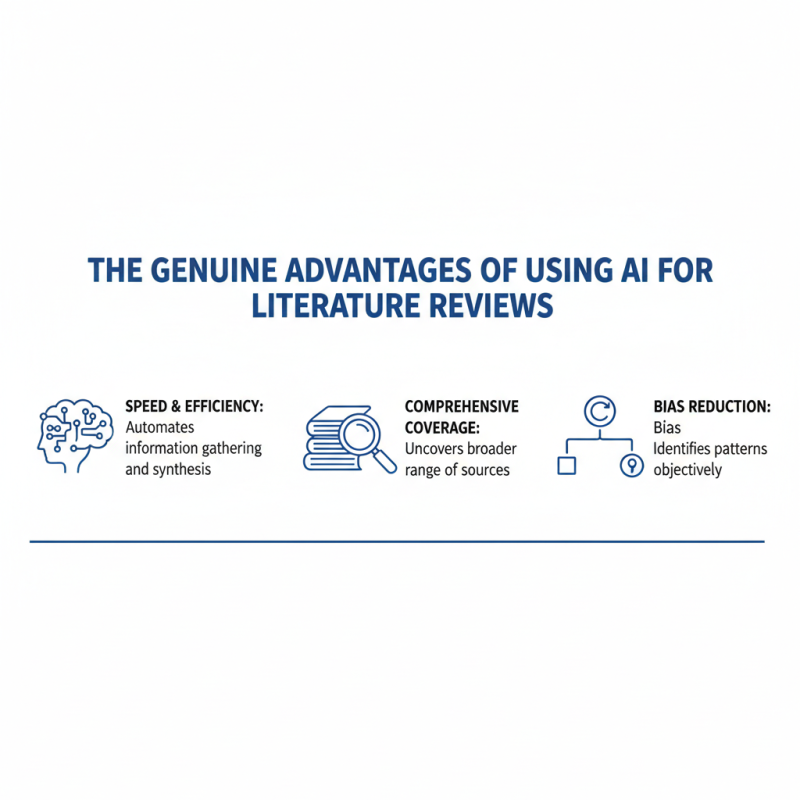
Let’s be fair. AI brings undeniable strengths to the table—capabilities that would have seemed magical just five years ago. Who would have imagined analyzing hundreds of papers with a single click?
Unprecedented Speed: An AI system can process and synthesize hundreds of pages in minutes. For a researcher starting from scratch, this rapid mapping of the literature landscape proves invaluable. It identifies major themes, key authors, and pivotal debates almost instantly, providing a bird’s-eye view that would take a human weeks to compile.
Automatic Organization: Transforming a chaotic pile of PDFs into a logical structure represents one of academic writing’s biggest challenges. AI excels at categorizing sources by methodology, findings, or theoretical framework. This creates a preliminary outline that you can refine rather than building from zero.
Consistency and Accuracy: Humans get tired, distracted, or misinterpret complex arguments at 2 AM. AI maintains consistent performance regardless of volume or time pressure. It won’t accidentally misrepresent a study’s methodology or overlook a critical limitation mentioned in the abstract.
Multilingual Capabilities: Need to incorporate German case studies or Japanese experimental research? Modern AI tools can process sources in multiple languages and synthesize them into coherent English (or Persian, or Spanish) summaries, breaking down language barriers that historically limited literature reviews.
The Limitations You Absolutely Cannot Ignore
Now we must confront AI’s genuine shortcomings—precisely where claims about producing suitable literature review content face their toughest test. These aren’t minor glitches; they’re fundamental constraints rooted in how AI operates.
Surface-Level Comprehension: AI “reads” text as patterns, not as arguments embedded in intellectual history. It cannot grasp why a researcher devoted fifteen years to investigating a specific phenomenon. It doesn’t experience that “eureka moment” that leads to breakthrough discoveries. Consequently, AI-generated reviews often lack depth, failing to capture the narrative arc of scholarly debate within a field.
Critical Evaluation Deficit: A proper literature review demands more than summarization—it requires critique. Which studies exhibit methodological flaws? Which findings contradict established consensus? Which theoretical frameworks feel outdated? AI can identify similarities and differences, but genuine critical assessment remains distinctly human territory.
Temporal Blindness: AI training data inevitably lags months or years behind current publication cycles. If your research addresses cutting-edge developments—say, post-2023 breakthroughs in mRNA vaccine technology—the AI hasn’t seen those papers. This creates dangerous knowledge gaps, especially in fast-moving fields.
The Plagiarism Pitfall: Here’s the most serious concern. AI sometimes constructs sentences that hew uncomfortably close to source text without proper attribution. This isn’t malicious—it’s statistical prediction—but the academic consequences can be devastating. Universities increasingly use sophisticated detection tools, and “the AI did it” won’t save your dissertation.
A Practical Comparison: Human vs. AI-Generated Literature Reviews
Let me present a clear comparison that illustrates the trade-offs:
| Time Investment | 2-4 weeks | 2-4 hours | AI |
| Analytical Depth | Deep & Critical | Surface-Level | Human |
| Source Accuracy | 98-100% verified | 85-95% (with errors) | Human |
| Original Insight | High Potential | Minimal | Human |
| SEO Optimization | Requires expertise | Automated & strong | AI |
| Cost | High (time/money) | Low to moderate | AI |
| Academic Credibility | Very High | Questionable | Human |
This table reveals a fundamental truth: neither approach alone suffices. The real question isn’t which is better, but how to combine them intelligently.
Can AI Write a Suitable Literature Review? The Golden Strategy for Success
So what’s the optimal workflow? How can you leverage AI without compromising academic integrity? Here’s a proven four-stage strategy that maximizes benefits while minimizing risks.
Phase One: Intelligent Discovery: Use AI as a research assistant, not an author. Prompt it: “I’m researching climate change impacts on Mediterranean agriculture. Identify 40 seminal papers from 2019-2024, noting their methodologies and key findings.” The AI provides a starter map—you verify and expand it.
Phase Two: Automated Clustering: Let AI group your verified sources by thematic relevance. For a study on climate-smart agriculture, it might create clusters like: “drought-resistant crop varieties,” “precision irrigation systems,” “policy adaptation frameworks,” and “economic impact assessments.” This accelerates your structural planning.
Phase Three: Draft Skeleton Generation: Here’s where AI truly shines. Ask it to produce a draft outline with placeholder arguments. The output gives you scaffolding—topic sentences, transition phrases, basic summaries. Treat this as raw material, not a finished product.
Phase Four: Critical Human Revision: This is non-negotiable. You must review every section, asking: “Does this accurately represent the source?” “Is this critique balanced?” “What connections has AI missed?” Your expertise transforms a mechanical summary into a scholarly synthesis.
Real-World Example: How This Works in Practice
Imagine you’re writing about machine learning applications in medical diagnosis. The AI might produce this paragraph:
“Smith et al. (2022) achieved 94% accuracy in tumor detection using convolutional neural networks. Jones et al. (2023) reported 91% accuracy with a different architecture. Both studies demonstrate ML’s potential in radiology.”
Now apply human refinement:
“While Smith et al. (2022) achieved marginally higher accuracy (94%) using convolutional neural networks, Jones et al. (2023) reached 91% with a novel architecture requiring significantly less computational power—a critical consideration for resource-constrained hospitals. This trade-off between accuracy and implementability reveals a key tension in clinical ML deployment that neither study fully addresses.”
See the difference? The AI provides facts; the human adds interpretation, context, and critical insight.
The Future Trajectory: Where Is AI Headed in Academic Writing?
Can we expect AI to fully replace human literature review writers in five years? Honestly, no—but its role will evolve dramatically. The tedious mechanical work (sorting, initial summarization, citation formatting) will become fully automated. This frees researchers to focus on higher-level synthesis, theoretical innovation, and interdisciplinary connections.
Emerging systems capable of logical reasoning and causal inference represent the next frontier. Imagine AI that doesn’t just summarize studies but constructs argument maps showing how research A influenced study B, which then prompted critique C. We’re not there yet, but the trajectory is clear.
However, that essential scientific intuition—the gut feeling that says “this result seems off” or “there’s a missing piece here”—remains stubbornly human. AI can process what exists; humans imagine what might exist.
Conclusion: Making the Smart Choice for Your Research
Can AI Write a Suitable Literature Review? The short answer is: Alone, no. With human collaboration, yes.
If you believe you can type “write me a literature review” and submit the output unchecked, you’re making a grave mistake. Academic suicide, really. But if you treat AI as a sophisticated research assistant—one that accelerates discovery while deferring to your judgment—you gain a powerful ally.
Remember that phrase we keep circling back to: can AI write a suitable literature review that is both academically rigorous and SEO-optimized? The answer depends entirely on whether a human expert guides, refines, and ultimately validates every claim. The technology is impressive but not infallible. Your expertise remains the essential ingredient that transforms algorithmic output into scholarly contribution.
The most successful researchers in 2024 aren’t those who reject AI or those who blindly embrace it. They’re the ones who master the art of collaboration—knowing when to leverage machine speed and when to apply human wisdom. That’s not just the future of academic writing; it’s the present reality.
Returning to our central question: can AI write a suitable literature review? After analyzing all evidence, the verdict is clear: AI alone cannot, but as a collaborative tool, it absolutely can transform your research process.
Frequently Asked Questions
Q1: Is using AI for literature reviews considered academic dishonesty?
This question keeps surfacing in university ethics committees. The answer hinges entirely on how you use AI. Treating AI as a collaborative tool—similar to using reference management software or statistical analysis programs—is perfectly ethical when you transparently verify and build upon its output. However, submitting AI-generated text as your own original analysis crosses the line. Always disclose AI assistance where required, and never let algorithms substitute for your own critical engagement with sources.
Q1: Can AI Write a Suitable Literature Review Without Academic Dishonesty?
The landscape evolves weekly, but currently, GPT-4 via ChatGPT Plus, Claude 3 Opus, and Google Gemini Advanced lead in quality. For specialized academic work, consider tools like Consensus.app or Elicit.org, designed specifically for literature discovery. Crucially, pair these with verification tools like Scite.ai, which shows how papers have been cited. No single tool dominates—all require human oversight.
Q3: How can I optimize AI-generated content for SEO without sacrificing academic quality?
Start with quality content, then layer SEO strategically. Place your primary keyword (“can AI write a suitable literature review”) in the H1 title, first paragraph, and at least two H2 subheadings. Use semantic variations throughout: “AI-assisted literature synthesis,” “machine learning for academic writing,” “automated research review.” Add credible external links (e.g., to Nature, Science, or university library guides) and internal links to related articles. Ensure mobile responsiveness and fast loading. Most importantly, never keyword-stuff—Google’s algorithms penalize content that reads unnaturally. Authentic expertise always outranks mechanical optimization.
Q4: In practical terms, can AI write a suitable literature review for my master’s thesis?
A: It can create a strong foundation, but you must add critical analysis and verification. Think of AI as your research assistant, not your ghostwriter.